Searches for "Delaware Incorporation" and "Stripe Atlas" in Canada Hit Five-Year Highs During YC Policy Shift
Short Answer: Canadian Google searches for "Delaware Incorporation" and "Stripe Atlas" surged to five-year highs from November through January 2026, coinciding with Y Combinator's temporary removal of Canada from its accepted incorporation countries — signaling growing founder anxiety about staying Canadian-incorporated.
Canadian search interest in "Delaware Incorporation" and "Stripe Atlas" reached five-year highs from November through January, according to the Google Trends screenshots published with this article. The timing overlapped with Y Combinator's decision to remove Canada from its list of accepted countries of incorporation, a change first reported on January 26, 2026, before the accelerator reversed course on February 5.
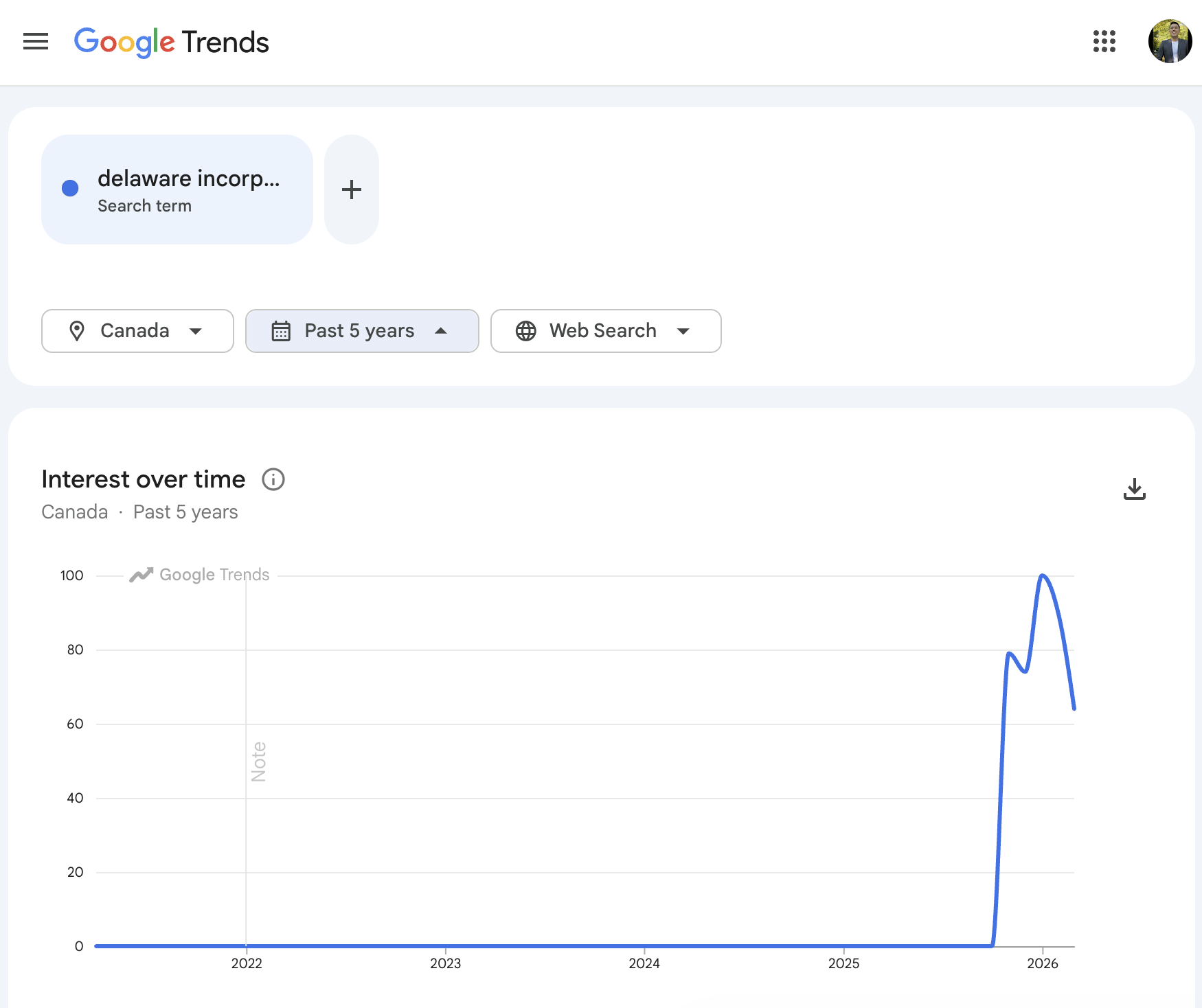
The overlap matters because both search terms point to a specific founder decision: whether to set up a company in Delaware rather than Canada. Stripe Atlas is one of the best-known tools for doing exactly that. Stripe says more than 100,000 founders have used Atlas to incorporate in Delaware, and describes the product as a fast path to forming a startup, obtaining a tax ID, issuing founder equity, and getting operational in the U.S. system.
The search spike does not prove that every founder who typed those terms went on to reincorporate. Google Trends measures relative search interest, not completed filings. But the surge is still meaningful as an early signal of founder intent, especially at a time when Canadian founders were already confronting a widening perception that serious venture-backed companies may eventually need a U.S. legal wrapper to raise and scale. That broader concern has been building for some time. BetaKit previously reported that only 32.4 percent of Canadian-led high-potential startups founded in 2024 were headquartered in Canada, while nearly half were based in the United States.
Y Combinator's Canada decision appears to have intensified an existing market fear
Y Combinator's temporary removal of Canada did not create founder interest in Delaware. It appears to have intensified an anxiety that was already present.
When BetaKit reported the change in January, the practical implication was clear: Canadian startups seeking YC funding would need to incorporate in another approved jurisdiction, such as the United States, the Cayman Islands, or Singapore. When YC reversed the change on February 5, Garry Tan said the firm had removed Canada because many of its top-performing Canadian companies later reincorporated in the U.S., likely because a U.S. structure made access to investor capital easier at Demo Day.
That explanation likely landed hard in Canada because it reinforced a fear that already existed in founder circles: that remaining Canadian-incorporated can make a startup look less investable to U.S. capital, even when the business itself is strong.
"Stripe Atlas" signals more than curiosity about U.S. startups
Interest in "Stripe Atlas" is especially revealing because Atlas is not just a media brand or venture buzzword. It is a product specifically associated with Delaware company formation. Stripe says Atlas now helps founders in more than 140 countries incorporate in Delaware, and reported in late 2025 that Atlas incorporated 23,000 companies that year alone, including one in five Delaware C corporations.
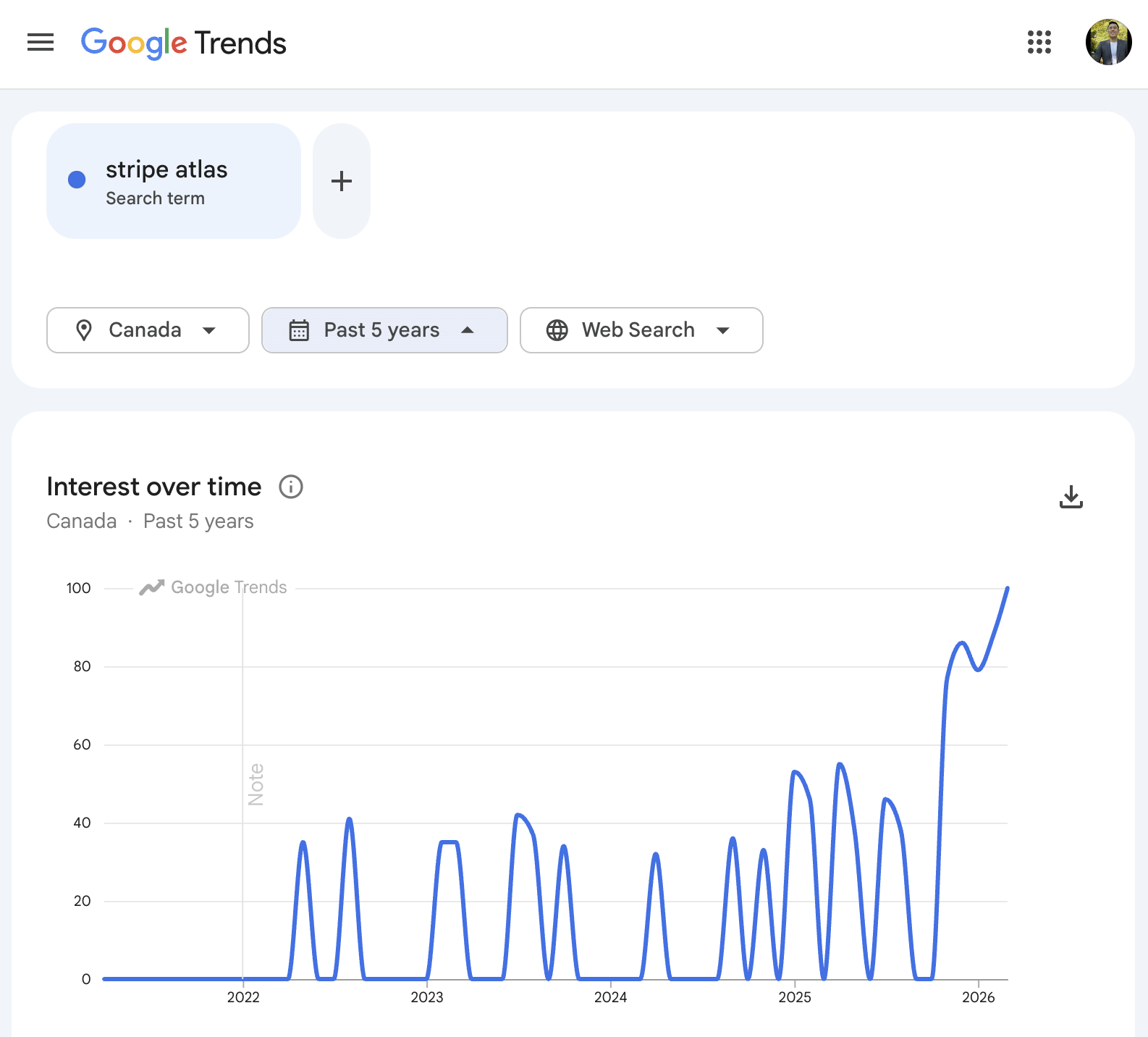
That makes a spike in Canadian searches for "Stripe Atlas" more significant than a general rise in discussion about U.S. venture capital. It suggests that at least some founders were not simply debating Delaware in the abstract. They were likely exploring a concrete pathway.
LegalBooks says the "Delaware equals investable" narrative is spreading
LegalBooks, which services roughly 150 startups in Canada, says a recurring theme in founder conversations is the belief that a Delaware incorporation can transform a company from "Canadian" and therefore constrained into "American" and therefore fundable.
That perception has become more common even though the underlying legal and commercial reality is more complicated. A Delaware C corporation can be the right structure in some situations, particularly when a company's investor base, hiring plan, customer footprint, and long-term operating center are moving into the United States. But legal domicile does not substitute for product-market fit, strong revenue quality, customer demand, or venture-scale economics.
LegalBooks points to a different lived example: a Canadian company can remain Canadian and still attract backing from large U.S. funds and senior technology operators. The problem, in that reading, is not that Delaware is always the wrong answer. The problem is that too many founders may be starting to treat it as a default answer.
Commercial pressures are also pushing founders toward the U.S.
The incorporation debate is not only about fundraising optics. It is also about where founders believe they can sell.
LegalBooks says founders, particularly in healthcare AI, often describe Canada as a difficult environment for commercial adoption. In publicly run systems, procurement cycles can be slower, buyer incentives can be weaker, and institutional urgency around cost-efficiency tools may not match what founders see in parts of the U.S. healthcare market. A U.S. hospital or healthcare operator facing harder economic pressure may be more motivated to adopt technology that improves margins, throughput, or staffing efficiency.
The same pressure shows up outside healthcare. Canada's smaller population, narrower enterprise base, and shallower domestic market can make the United States feel less like an expansion opportunity and more like the main market from day one.
The deeper issue is founder confidence, not just incorporation mechanics
The most important signal in the Google Trends spike may be psychological rather than procedural.
Founders typically search before they act. Search interest often appears before legal instructions are sent, before counsel is retained, and before a Delaware parent is formed. That makes a rise in search activity relevant even if it cannot, by itself, prove a wave of completed reincorporations.
For Canada, that distinction matters. Once founders begin treating the United States as the default place to raise, sell, and scale, the legal move often follows. The long-term consequences extend beyond a certificate of incorporation. Over time, they affect where IP is housed, where jobs are created, where tax revenue lands, and where strategic decisions are made.
A search spike can be an early warning sign for Canada's startup economy
The clearest reading of the data is not that Delaware has suddenly become fashionable.
It is that a growing number of Canadian founders may be searching for an exit route from Canadian startup friction.
The combination of a visible YC policy shift, a surge in searches tied to Delaware incorporation, and ongoing founder frustration around capital access and market scale points to a broader structural issue. Canada may not have an incorporation problem so much as a founder-confidence problem: a growing belief that the most ambitious startups will need to become American earlier than they once did.
If that belief continues to harden, the consequences will go well beyond startup law. Canada will keep producing founders, ideas, and early innovation — while more of the downstream value creation migrates elsewhere.
Methodology
This article relies on Google Trends screenshots published alongside it showing Canadian search interest over a five-year period for the terms "Delaware Incorporation" and "Stripe Atlas." Google Trends measures relative search interest rather than absolute search volume or completed incorporation filings.
LegalBooks automates post-incorporation legal workflows for Canadian startups — from minute books to equity tracking to fundraising legal documents. Over 6,000 legal tasks completed monthly.